Commercial Roof Moisture Scans in West Palm Beach & South Florida
Your Roof May Be Failing and You'd Never Know Without This
A commercial flat or low-slope roof can trap moisture for months, even years before any visible sign appears inside the building. By the time staining shows up on a ceiling tile or water drips through a fixture, the damage underneath is often far more extensive than it appears.
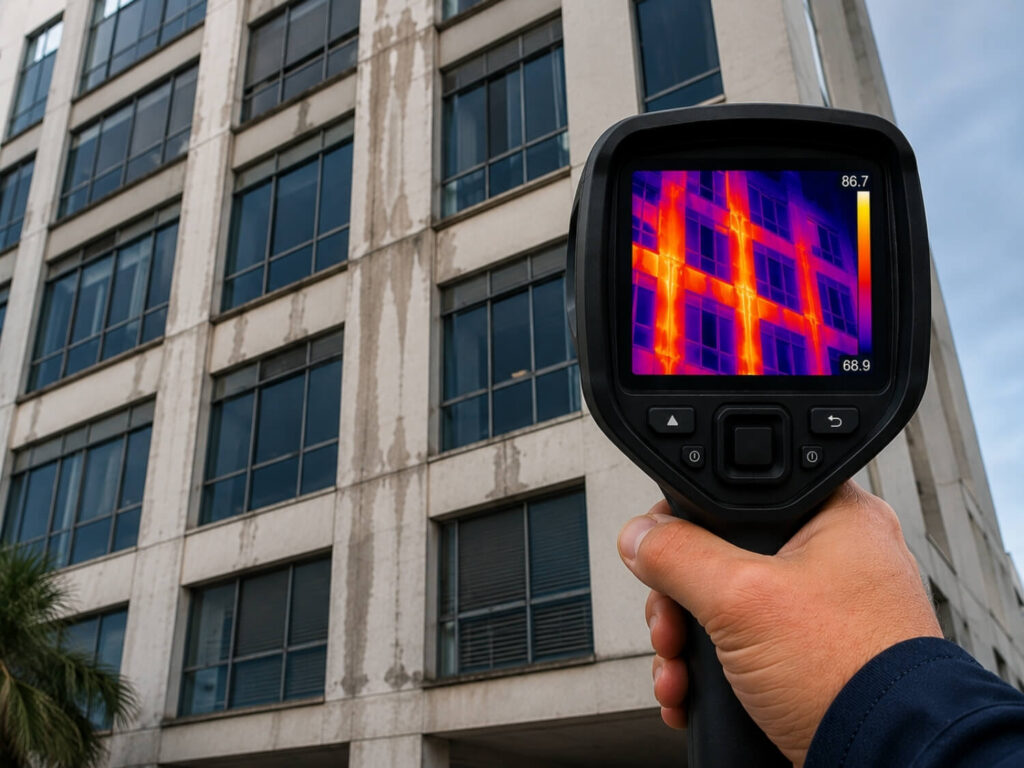
Infrared thermography identifies the temperature difference between wet and dry roofing insulation, wet materials retain heat longer than dry ones, creating thermal signatures that are clearly visible to a calibrated infrared camera during the right conditions. Delta Infrared Solutions has been performing commercial roof moisture scans in South Florida for more than 15 years, helping property owners avoid unnecessary full roof tear-offs, prioritize targeted repairs, and protect the value of one of a building’s most expensive assets.
Why Florida Roofs Are Especially Vulnerable
- Extreme heat causes roof membranes to expand, contract, and eventually crack
- High humidity means moisture is almost always looking for an entry point
- Intense tropical rainfall puts roofing systems under pressure regularly
- Hurricane-force winds can compromise seams, flashings, and membranes in ways that are not immediately obvious
- Seasonal thermal cycling stresses attachment systems and accelerates wear
Signs Your Commercial Roof May Need an Infrared Moisture Scan
- Interior ceiling stains or water marks that come and go
- A roof that is several years old without a documented moisture survey
- Recent high winds or heavy rain events
- A new roof showing unexplained interior moisture
- Pre-purchase due diligence for a commercial property acquisition
- Insurance renewal requirements or claim documentation needs
- Preparation for a roofing contractor bid, know what you actually need repaired before you get quotes
- You have already had areas repaired but moisture problems persist
The ASTM Standard That Governs Roof Moisture Scanning
Commercial roof moisture scanning is governed by ASTM C1153, the Standard Practice for the Location of Wet Insulation in Roofing Systems Using Infrared Imaging. This standard establishes the protocols for when inspections must be performed, how conditions must be evaluated, and how findings must be documented.
At Delta Infrared Solutions, we follow ASTM C1153 protocols on every commercial roof moisture scan, meaning our reports hold up to scrutiny from engineers, insurers, and contractors.
Our Process
What Our Roof Moisture Scan Process Looks Like
Step: 1 Scheduling and Pre-Inspection Planning
Roof moisture scans must be conducted under specific weather conditions, typically within a few hours after sunset, when the roof surface is cooling and the temperature differential between wet and dry insulation is most pronounced. We coordinate scheduling to align with appropriate conditions and work around your building's operational needs.
Step 2: On-Site Scanning
Our thermographers walk the entire roof surface with professional-grade infrared cameras, systematically covering all areas. We mark suspect areas in real time and cross-reference with visible-light photography to document the full picture.
Step 3: Moisture Mapping and Reporting
Our deliverable is a clear roof moisture map, a visual overlay showing dry areas, suspect areas, and confirmed wet areas, along with a written report that documents the percentage of the roof affected, the location and estimated extent of wet insulation, and our recommendations for repair prioritization.
Step 4: If Wet Insulation Is Found
Our report gives your roofing contractor exactly what they need to target repairs efficiently. Instead of tearing off an entire roof, contractors can remove and replace only the wet sections, a process that can save tens of thousands of dollars. We can return after repairs to verify that affected areas have been addressed.
The Financial Case for Moisture Scanning
A full commercial roof replacement in South Florida can cost hundreds of thousands of dollars depending on the building size. An infrared moisture scan typically costs a small fraction of that, and it tells you whether you actually need a full replacement or whether targeted repairs will extend the roof’s life for years.